


When homeowners compare termite control in Surprise AZ, the first number they usually look at is the treatment price.
The second number should probably be the warranty.
A termite treatment may cost a little more or a little less depending on the company, product, size of the home, construction type, attached concrete, and extent of the treatment. But the real difference between two proposals may not become obvious until a year or two later when termites return and the homeowner discovers exactly what their warranty does, or does not, cover.
A “5-year warranty” sounds simple.
It is not always that simple.
Does the company charge an annual renewal fee?
Does the warranty cover the whole structure or only the original treatment area?
Does retreatment cost extra?
Can the warranty transfer to a new homeowner?
Are annual inspections included?
What happens if landscaping disturbs treated soil?
Was the original treatment properly documented?
What product was actually used?
Those details matter.
Arizona has significant subterranean termite pressure. Some areas may have up to 20 subterranean termite colonies per acre, and the colonies living underground do not disappear after one home receives a termite treatment.
A good termite warranty should provide homeowners with a clear plan if activity returns.
It should not leave them wondering what they actually purchased.
Here are 12 costly termite warranty mistakes homeowners should avoid before choosing a termite company.
1. Assuming Every 5-Year Termite Warranty Is the Same
This is probably the biggest mistake.
Two companies may both advertise a “5-year termite warranty,” but the cost and coverage can be very different.
For example, one company may provide the first year and then require an annual renewal fee to keep the remaining warranty active.
Another may include the entire initial warranty period without additional annual charges.
Those are not financially equivalent.
Imagine Company A charges less for the initial treatment but requires several hundred dollars in renewal or inspection fees over the next five years.
Company B has a slightly higher initial treatment price but does not charge annual renewal fees during that same period.
The cheaper proposal on day one may not actually be cheaper over five years.
Before signing anything, ask:
- How long is the initial warranty?
- Are there annual fees?
- When do renewal fees begin?
- Is an inspection required every year?
- What happens if I skip an inspection?
- What exactly is covered if termites return?
At TermiKnight, our complete Termidor HE treatments include a 5-year initial warranty with no annual renewal fee during those first five years.
After the initial five years, the warranty can be renewed annually for continued protection up to 10 years.
The initial treatment price should not be the only number you compare.
2. Looking Only at the Treatment Price
Everyone wants a good price.
I understand that completely.
But comparing termite quotes only by price can be misleading if the companies are not providing the same service.
One proposal might include:
- Complete exterior treatment
- Garage treatment
- Attached patio treatment where necessary
- Plumbing areas
- Expansion joints
- Termidor HE
- Five years of warranty coverage
Another proposal might treat only the area where activity was found.
Those are very different services.
A homeowner might see:
Company A: $750
Company B: $1,295
and assume Company A is the obvious choice.
Maybe it is.
But first find out what each company is actually doing.
Ask whether the proposal is for:
- A spot treatment
- A partial treatment
- A complete structural treatment
- A bait system
- A liquid soil treatment
Then compare the product, treatment areas, warranty, renewal fees, and retreatment terms.
Professional termite treatment in Surprise AZ should be compared based on what is actually included, not simply which proposal has the smallest number at the bottom.
3. Confusing a Retreatment Warranty With a Damage-Repair Warranty
This distinction is extremely important.
A termite warranty may cover retreatment if termites return, but that does not automatically mean the company is responsible for repairing termite-damaged wood.
Those are separate things.
The Arizona Department of Agriculture specifically advises homeowners to review their original pest-control agreement to determine whether coverage includes only retreatment or also covers structural damage. Private warranty terms are governed by the agreement between the homeowner and company.
At TermiKnight, our termite warranty is a retreatment warranty.
If covered termite activity returns and retreatment is necessary, we perform the appropriate retreatment under the warranty.
It is not a structural damage-repair bond.
Homeowners should understand this distinction before hiring any termite company.
Do not assume the word “warranty” automatically means:
“We will replace every piece of wood termites ever damage.”
Read what the warranty actually says.
A reputable company should be able to explain it clearly.
4. Assuming a Spot Treatment Gives You a Whole-House Warranty
If termites are found in one bathroom, one garage wall, or one exterior area, a homeowner may choose to treat only that location.
That can be a reasonable option when the homeowner understands the limitation.
The problem occurs when a localized treatment is mistaken for whole-house protection.
Subterranean termites live underground.
The termites visible in one wall represent only a small portion of the colony.
The same colony, or another colony entirely, may approach a different part of the home later.
A spot treatment does not create a treated zone around the entire structure.
That is why I do not provide a whole-house termite warranty on a localized spot treatment.
I cannot reasonably warranty areas that were never treated.
If a homeowner chooses a complete Termidor HE treatment, that is different.
The goal becomes protecting the structure as a whole wherever construction allows.
That is what allows us to provide whole-house warranty coverage.
When comparing proposals, ask one very simple question:
“Does this warranty cover my entire home, or only the areas you are treating today?”
The answer matters.
5. Not Asking What Termiticide Is Being Used
A warranty tells you what happens after treatment.
The product tells you a lot about what is being done during treatment.
Homeowners should know the exact termiticide being applied around their property.
At TermiKnight, I use Termidor HE for post-construction subterranean termite treatments.
It is a non-repellent termiticide.
That means termites do not simply encounter the treated soil and immediately recognize it as something they need to avoid.
Workers can move through treated areas and become exposed.
Because termites are social insects that interact through normal contact and grooming, exposure can extend beyond only the worker that initially passes through the treated soil.
That is important because the worker termites you see are not the entire problem.
The queen remains underground and may produce approximately 300 to 500 eggs per day.
A few termites visible inside a mud tube represent only a small part of the colony.
If you are comparing termite proposals, ask:
“What exact product are you using?”
Do not settle for:
“We use the good stuff.”
Ask for the product name.
6. Not Asking Which Areas of the Home Are Included
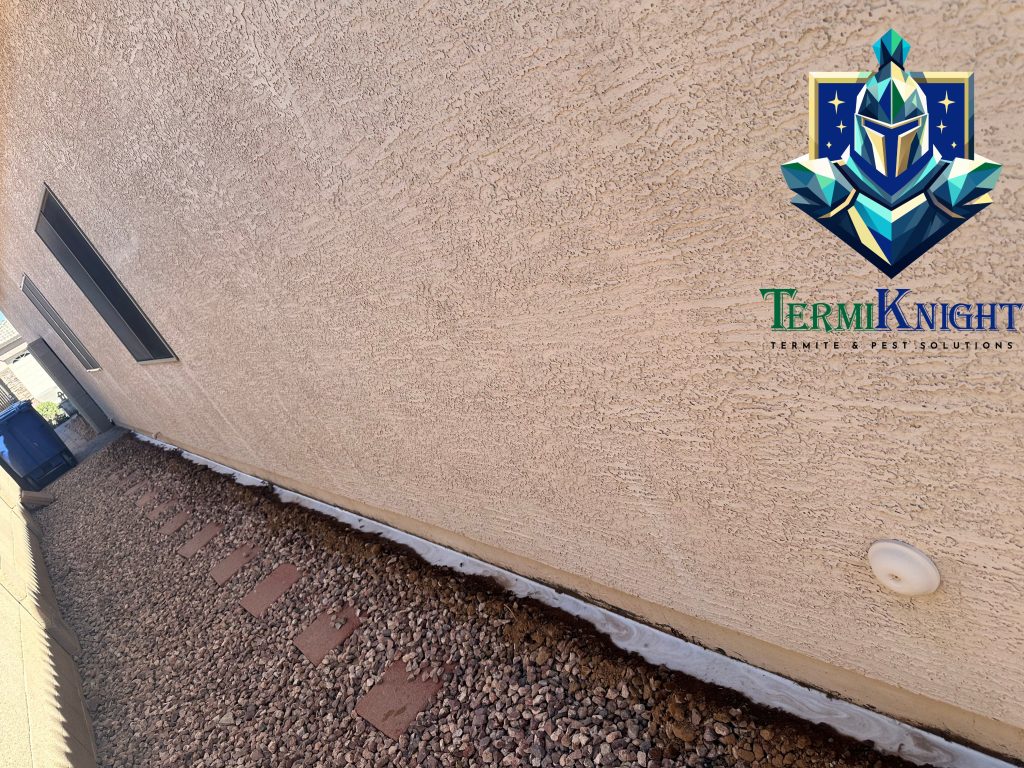
A whole-house treatment should make sense for the construction of the home.
That does not mean every house receives the exact same drilling pattern.
Arizona homes can have:
- Post-tension slabs
- Floating slabs
- Stem walls
- Attached garages
- Attached patios
- Walkways
- Plumbing penetrations
- Expansion joints
- Add-on concrete
A post-tension slab should not be treated exactly like a floating slab.
Interior drilling is generally avoided on post-tension slabs because of the cables inside the concrete.
Attached patios or concrete may require treatment to reach soil underneath them where appropriate.
Garage construction may create different treatment points than the living area.
Before signing a proposal, ask exactly what is included.
Is the garage included?
Are attached patios included where treatment is required?
What about plumbing penetrations?
What about expansion joints?
What happens if decorative rock or landscaping is against the foundation?
A warranty is only as useful as the treatment behind it.
7. Ignoring Annual Renewal Fees
This one can become expensive over time.
Some termite programs have a relatively low initial cost but require annual payments to maintain coverage.
There is nothing inherently wrong with a renewal fee if the homeowner understands it.
The problem is when the homeowner believes they purchased five years of protection and later discovers that the warranty ends unless another payment is made after the first year.
Ask for the total cost.
If a company requires annual payments, calculate what the treatment will cost over:
- 3 years
- 5 years
- 10 years
That creates a much more useful comparison.
At TermiKnight, there is no annual renewal fee during the first five years of our complete-treatment warranty.
After five years, customers can choose to renew annually for continued protection up to 10 years.
I prefer making that clear before the customer signs anything.
No surprises a year later.
8. Forgetting to Ask Whether the Warranty Transfers
You may not be planning to sell your home today.
That can change.
A job transfer happens.
A larger home becomes necessary.
Someone downsizes.
Life changes.
If you sell a house with remaining termite warranty coverage, a transferable warranty can be useful for the next homeowner.
Termites are common in Arizona.
Finding out that a property has been treated for termites is not unusual.
What buyers generally want to know is:
- When was it treated?
- What product was used?
- Was the whole home treated?
- Is there current activity?
- Is there a warranty?
- Can that warranty transfer?
A documented professional treatment with remaining transferable coverage provides much more information than:
“The previous owner said someone sprayed for termites a few years ago.”
At TermiKnight, our complete-treatment warranty is transferable.
That helps keep the treatment history attached to the property instead of only to the person who originally purchased the service.
9. Assuming a Warranty Means Termites Can Never Return
No termite company can realistically remove every subterranean termite colony from Arizona.
The goal of professional termite control is to protect the structure.
Even after a successful treatment, other colonies remain throughout the surrounding soil.
Remember, some Arizona areas may have up to 20 subterranean termite colonies per acre.
That is why a warranty matters.
A termite warranty should not be interpreted as:
“Termites are physically incapable of ever appearing again.”
It means there is a defined response if covered termite activity returns.
This distinction is important.
Termites may approach the structure years later from a different direction.
Landscaping may disturb treated soil.
Construction may change.
New concrete may be added.
Irrigation may be installed.
The environment surrounding the house can change substantially over five or ten years.
The value of a warranty is knowing what happens next if termites show up again.
10. Disturbing Treated Soil and Never Telling the Termite Company
Liquid termite treatments depend on properly treated areas around the structure.
If those areas are later excavated or significantly altered, termite protection can be affected.
Common examples include:
- Paver installation
- Artificial turf
- Irrigation trenches
- Pool construction
- Concrete patios
- Sidewalks
- Hot tub pads
- Raised planters
- Grading
- Utility work
- Room additions
Suppose the soil along the foundation is treated today.
Two years later, a landscaper excavates that same soil to install pavers.
The environment that existed during the termite treatment has now changed.
That does not automatically mean the entire house needs another treatment.
It does mean the affected area may need to be evaluated.
If your home has a termite warranty, contact the treating company before major excavation around the foundation whenever possible.
It is much easier to protect the treatment before the project than to determine what was removed afterward.
This is also why homeowners should read the warranty and understand any conditions involving soil disturbance or structural modifications.
11. Losing Your Treatment Records
Keep your termite paperwork.
Seriously.
Years later, it may be more valuable than you expect.
Keep records showing:
- Treatment date
- Product used
- Areas treated
- Warranty period
- Renewal terms
- Previous activity
- Retreatment history
- Inspection reports
- Transfer information
Arizona also maintains termite treatment and inspection records through the Termite Action Report Form, commonly called a TARF.
The Arizona Department of Agriculture says licensed businesses must submit TARFs for certain termite actions, including initial corrective treatments and WDIIRs, and the state maintains a searchable treatment-history database.
That documentation can be extremely useful when a property is sold or when a homeowner is trying to determine what happened years earlier.
At TermiKnight, I record the appropriate TARF for qualifying termite treatments.
I also provide customers with their warranty information so they have a record of what was performed.

12. Waiting Until You Are Selling the House to Figure Everything Out
This happens more often than homeowners expect.
Someone decides to sell.
Then suddenly everyone wants to know:
Was the house treated?
When?
By whom?
What product was used?
Is there a warranty?
Was the entire house treated?
Is there current activity?
Where is the paperwork?
Trying to reconstruct years of termite history during a real estate transaction creates unnecessary stress.
Keep the information organized from the beginning.
If you purchased a home and do not know its termite history, it may also be worth researching available records instead of waiting until a future problem occurs.
A WDIIR, or Wood-Destroying Insect Inspection Report, is also different from a routine free termite inspection.
A WDIIR is a specific report used in real estate and other transactions to document visible evidence and conditions associated with wood-destroying insects.
The treatment warranty and WDIIR serve different purposes.
Knowing the difference makes real estate transactions much easier.
What Does the TermiKnight Termite Warranty Include?
For a complete post-construction Termidor HE treatment, TermiKnight provides:
- 5 years of initial warranty coverage
- No annual renewal fee during the first five years
- One annual termite inspection available upon request during the covered period
- Retreatment when necessary under the warranty
- Transferable coverage
- Annual renewal options after year five
- Coverage renewable up to 10 years total
The warranty is designed to provide a straightforward answer to a simple question:
What happens if termites come back?
If covered termite activity returns and retreatment is necessary, we address it.
I do not want customers wondering whether they have to purchase an entirely new termite treatment every time they see a suspicious mud tube.
That is the purpose of having a warranty.
Does a 5-Year Warranty Mean Termidor HE Only Lasts Five Years?
No.
The warranty period and the biological longevity of a treatment are not the same thing.
A warranty is the period during which the company agrees to provide the specific coverage described in the agreement.
It should not be interpreted as an exact expiration date for every molecule of termiticide in the soil.
Many factors can influence termite protection over time, including:
- Soil conditions
- Moisture
- Landscaping
- Excavation
- Construction changes
- Concrete additions
- Irrigation
- Treatment coverage
That is why I prefer giving homeowners a clear warranty period rather than making unrealistic promises that a home can never experience termites again.
What Happens If Termites Return During the Warranty?
The first step is an inspection.
Seeing something that looks like termite activity does not automatically mean the entire property needs to be treated again.
The evidence may be:
- Old activity
- New activity
- Activity in a previously untreated area
- Activity associated with disturbed soil
- Something unrelated to termites
If active subterranean termites are confirmed in a covered area and retreatment is necessary under the warranty, the affected area can be retreated.
A warranty gives the homeowner a process.
Without one, every recurrence can become a completely new service call and expense.
Should You Have Your Home Inspected Every Year?
There is value in periodically looking at the property, especially in Arizona.
At TermiKnight, customers with covered complete treatments can request one annual termite inspection during the warranty period.
You should also keep an eye on the home yourself.
Look around:
- Garage walls
- Foundation edges
- Plumbing penetrations
- Patios
- Exterior stucco
- Expansion joints
- Baseboards
- Areas near irrigation
You do not need to become a termite expert.
You are simply looking for changes.
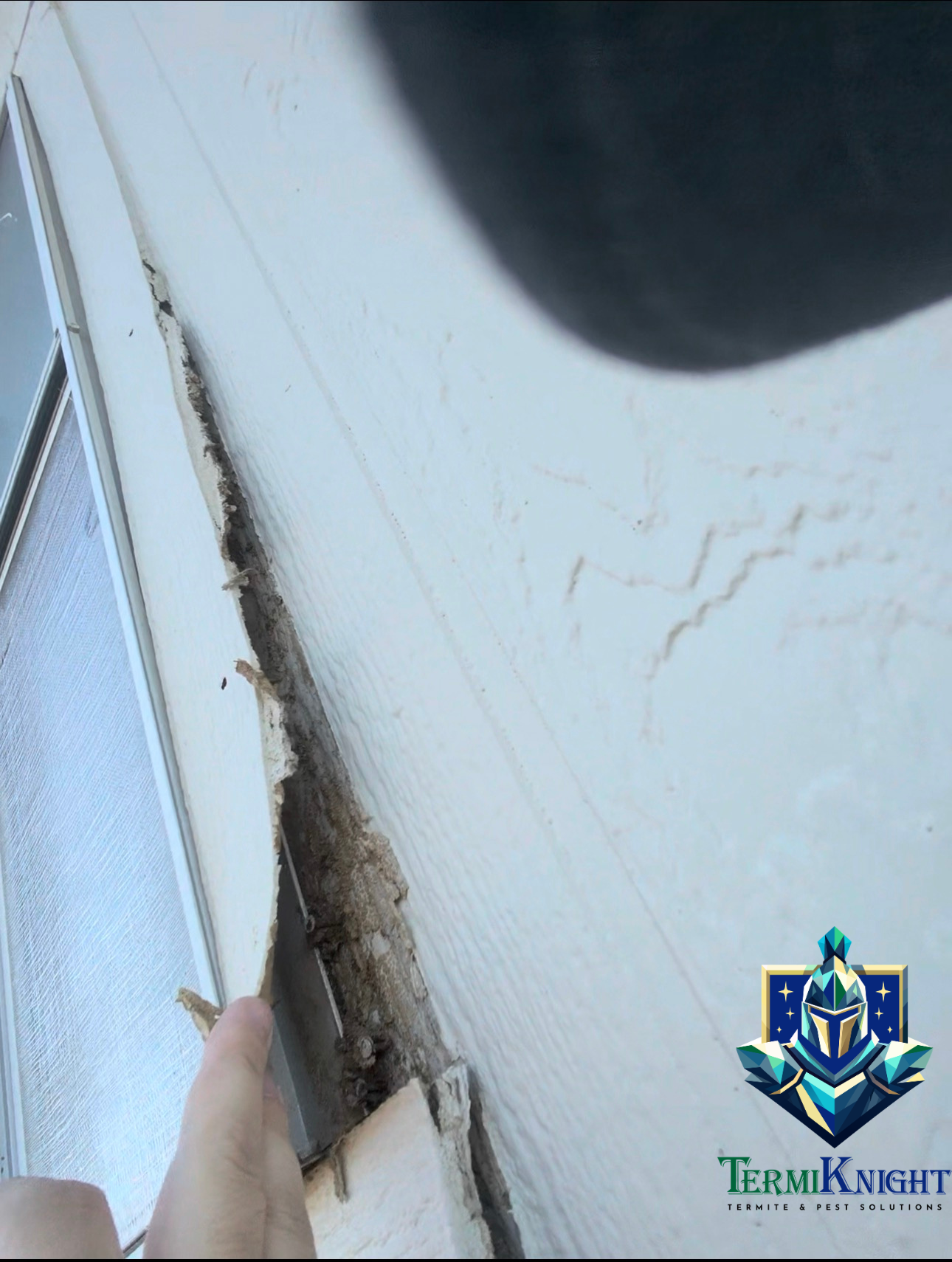
New mud.
Discarded wings.
Damaged wood.
Something that was not there before.
If you see something suspicious, call.
What Does a Termite Warranty Not Replace?
A warranty does not replace basic home maintenance.
Termite protection works best when homeowners also manage conditions around the structure.
Watch for:
Irrigation leaks
A damaged drip line can continuously soak soil beside the foundation.
Poor drainage
Water should not repeatedly collect against the home.
Plumbing leaks
Hidden water sources can create favorable conditions for termites.
Excessive soil or decorative rock
When soil or rock is piled too high against stucco, visible inspection areas can disappear.
Wood-to-soil contact
Wood should not be stored directly against the structure or buried in soil.
Major landscaping changes
Excavating treated soil can affect termite protection.
Moisture does not magically create termite colonies.
The colonies already exist underground.
But moisture and hidden access can make an area more favorable.
Why I Prefer Termidor HE for Warranty-Backed Treatments
A warranty is only part of the equation.
I also want confidence in the treatment behind that warranty.
That is why Termidor HE is my preferred post-construction product.
Termidor HE is non-repellent and allows me to create a treated zone around the structure wherever construction allows.
The goal is to intercept subterranean termites as workers move between the surrounding soil and the house.
That makes more sense to me than waiting for termites to discover individual bait stations.
Bait systems rely on termites encountering stations spaced around the property.
There are untreated areas between those stations.
I have personally inspected properties where bait stations were present while termites continued attacking the house.
That does not mean bait stations can never work.
It means I prefer protecting the structure directly.
Moisture is another consideration.
Irrigation and drainage problems may create wet conditions around bait stations, and heavily moldy feeding material may become less attractive to termites.
Bait programs also typically require ongoing monitoring.
For my customers, I prefer a complete Termidor HE treatment followed by clear multi-year warranty coverage.
Why Treatment Documentation Matters in Arizona
Termite activity in Arizona is common enough that treatment history can become part of a home’s long-term record.
That is actually a good thing.
A documented termite treatment tells a future homeowner much more than having no information at all.
If I were buying an Arizona home, I would rather know:
- Termites were found
- A licensed company treated them
- Termidor HE was used
- The treatment was recorded
- The warranty is active
than have no treatment history and no idea whether anyone ever inspected the structure.
Termite history should not automatically scare buyers.
Undocumented or untreated termite activity is the bigger concern.
Is a Transferable Termite Warranty Useful When Selling?
Yes.
A transferable warranty can give the buyer continued protection after ownership changes.
It also gives the buyer a company to contact if suspicious activity appears.
Instead of starting from zero, the new owner has:
- Treatment history
- Product information
- Warranty information
- A company familiar with the property
For Arizona real estate, that can be valuable.
It does not mean a warranty guarantees termites will never appear.
It means there is already a plan if they do.
Does Every Old Mud Tube Mean the Warranty Needs to Be Used?
No.
Old termite evidence can remain visible long after termites are gone.
An old mud tube does not automatically mean termites are currently active.
Indicators that deserve closer attention can include:
- Live termites
- Fresh, moist mud
- Recently rebuilt tubes
- New tubes that were not present before
- Fresh damage
- Swarmers
- Newly discarded wings
If you are unsure, have it inspected.
Do not automatically pay for another termite treatment because you discovered an old tube.
At the same time, do not ignore obvious new activity because you assume it is left over from years ago.
An inspection can usually provide much better context.
Arizona Termites Do Not Take the Winter Off
November is here, and temperatures are finally becoming more comfortable around the Valley.
Termite swarmers are much less noticeable than they were during Arizona’s major swarming periods from approximately March through May and July through September.
But subterranean termite colonies remain underground.
Worker termites do not pack up for winter and move out of Arizona.
The soil provides a much more stable environment than the air above it.
That means termite protection still matters during fall and winter.
In fact, this can be a great time to inspect the home because homeowners are not distracted by monsoon storms and summer heat.
Walk around the foundation.
Look inside the garage.
Check plumbing areas.
Look behind stored items.
If something looks suspicious, have it inspected.
Questions to Ask Before Signing Any Termite Warranty
Before choosing a termite company, you should be able to answer these questions:
What exact product is being used?
Is this a spot treatment or complete treatment?
Which areas of the structure are included?
How long is the warranty?
Are there annual renewal fees?
Does retreatment cost extra?
Can I request an annual inspection?
Does the warranty transfer?
What happens if I install pavers or landscaping?
Does the warranty cover structural damage or only retreatment?
Will the treatment be properly documented?
Who do I call if termites return?
Those questions can tell you far more than comparing two prices.
The Cheapest Termite Treatment Is Not Always the Cheapest Long-Term Option
This does not mean the highest-priced company is automatically the best choice.
Price matters.
Homeowners should shop around.
In fact, I have no problem with customers using my proposal to compare companies.
Just make sure you are comparing the same thing.
A $700 localized treatment is not the same service as a complete structural treatment with Termidor HE and five years of warranty coverage.
A company charging $100 less initially but collecting annual fees may eventually cost more.
A bait system with recurring monitoring fees has a different long-term cost structure than a liquid treatment.
Compare the entire package.
Then make the decision that makes sense for your home and budget.
Professional Termite Control Should Come With Clear Expectations
You should not have to decode a termite proposal.
A homeowner should know:
What is being treated.
What product is being used.
What the warranty covers.
How long the warranty lasts.
Whether additional fees apply.
What happens if activity returns.
That is basic transparency.
A termite treatment is already stressful enough for most homeowners.
The paperwork should not make it worse.
Professional termite control in Surprise AZ should provide both effective treatment and a clear long-term plan.
Protect Your Home Before the Next Swarming Season
Arizona’s fall weather may make termites less visible, but the colonies remain underground.
This is a good time to review your current termite protection.
Ask yourself:
Do I know when my home was last treated?
Do I know what product was used?
Is my warranty still active?
Am I paying an annual renewal fee?
Does my warranty transfer?
Was it a full treatment or only a spot treatment?
Have I changed landscaping since the treatment?
Did I add pavers, turf, concrete, or irrigation?
Do I know where my paperwork is?
If you cannot answer those questions, it may be worth reviewing your records before termite activity becomes obvious again.
Schedule Your Free Termite Inspection
If you are unsure about your home’s termite protection, have found suspicious termite evidence, or simply want to know what your options are, TermiKnight offers free termite inspections throughout Surprise and the West Valley.
I will inspect the property, explain what I find, and tell you whether treatment is actually necessary.
If another company has already treated the home and you still have valid warranty coverage, I will tell you to contact them.
If an old mud tube appears inactive, I am not going to pretend it is a new infestation just to sell a treatment.
If treatment is needed, I will explain what areas need to be protected, what product I use, and exactly what warranty comes with the service.
✔️ Free termite inspections
✔️ $400 OFF complete termite treatment
✔️ Termidor HE post-construction treatments
✔️ 5-year initial warranty, renewable up to 10 years
✔️ No annual renewal fee during the first 5 years
✔️ One annual inspection available upon request
✔️ Retreatment included when necessary under the warranty
✔️ Transferable warranty
✔️ TARF recorded with the Arizona Department of Agriculture when required
📞 Call or text: (623) 241-2598
🏰🛡️ Protect your Castle with TermiKnight!



Leave a Reply